
MILLION-DOLLAR SHIPBUILDING ORDERS AND THE RACE TO FIND SKILLED WORKERS
High-tech shipbuilding orders are continuously creating new opportunities for companies under the Shipbuilding Industry Corporation (SBIC). However, as shipyards accelerate production, the shortage of labor—especially highly skilled technical workers—has become a major challenge.
Attractive Income and Overtime Opportunities
During the scorching summer days, production activities remain busy and urgent at workshops, shipyards, slipways, and docks operated by SBIC-affiliated shipbuilding companies in Hai Phong and Quang Ninh.

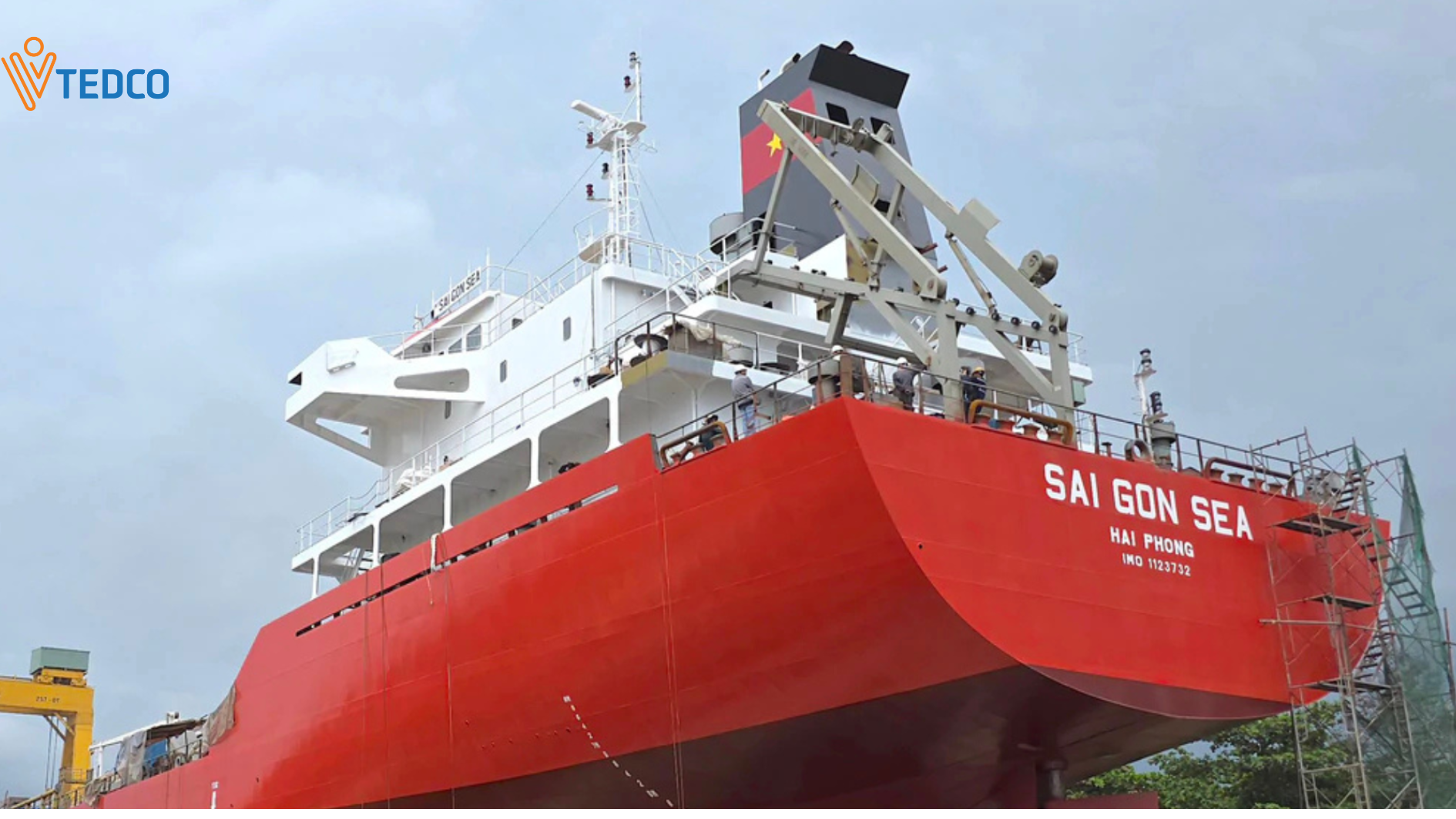
The offshore wind service vessel (CSOV) for export was newly built by Ha Long Shipbuilding Company for Damen, a Dutch shipowner.
Sparks from welding light up the workshops, while the sounds of steel-cutting and grinding machines echo continuously. Welders, steel workers, and electricians work tirelessly on every weld and connection to meet the deadlines of numerous shipbuilding contracts.
According to Mr. Nguyen Tien Dat, Deputy General Director of SBIC, the company’s member units are currently constructing various types of vessels. Among them, offshore wind service vessels are particularly valuable, with some contracts worth tens of millions of US dollars.
However, behind these ships taking shape lies a difficult challenge: while the number of orders continues to increase, the supply of skilled workers remains limited.
At Nam Trieu Shipyard, on the deck of a vessel currently in its final construction stage, Mr. Le Dang Hien, a Grade 5/5 welder, continues to work diligently. After 21 years in the industry, he says that with more orders coming in, workers now enjoy more stable employment and an average monthly income of around VND 16 million.
“With so much work, we often have to take on evening and night shifts. It can be tiring, but we encourage each other to keep going,” Hien shared.
According to Mr. Le Dinh Vinh, Deputy General Director of Nam Trieu Shipbuilding Company, the company is currently constructing three 9,300m³ oil and chemical tankers, which require highly advanced technical expertise.
In addition, the company is building a series of four 65,000-ton cargo ships and a 2,300m³ dredger for export to IHC in the Netherlands. These projects not only provide stable employment for more than 500 workers at Nam Trieu but are also expected to create jobs for approximately 1,000 workers employed by subcontractors through 2028.
No Shortage of Work
At Pha Rung Shipyard, after successfully delivering the fourth 13,000-ton oil and chemical tanker in a series of ten vessels to a South Korean partner, the company has continued to sign agreements and memoranda of cooperation for the construction of an additional ten 6,500-ton oil and chemical tankers designed to meet international standards.
According to Mr. Vu Huu Chien, General Director of Pha Rung Shipbuilding Company, orders for oil and chemical tankers, together with the repair of approximately 80 to 90 vessels each year, are expected to ensure stable employment for the company until 2030–2031.
Meanwhile, Ha Long Shipbuilding Company is currently working on 19 vessels of various types. Among the most notable projects are 14 offshore wind service operation vessels (CSOVs), dredgers for export to the Netherlands, and luxury yachts for the Australian market.
These are all modern vessels that require high standards of both technical expertise and aesthetic quality. In particular, CSOVs serving the offshore wind industry are equipped with advanced technologies and designed to meet international green standards.
These high-value and technologically demanding contracts are creating significant opportunities for the shipbuilding industry. However, they also place increasing pressure on companies to secure sufficient skilled labor.
The Difficult Challenge of Workforce Shortages
According to Mr. Le Dinh Vinh, the average age of the shipbuilding workforce is increasing. Many highly skilled workers are approaching retirement age, while the younger generation has not yet developed enough capacity to replace them.

Shipbuilding is a specialized industry that requires high-level technical skills and extensive training. After receiving basic training, a worker typically needs at least two additional years of practical experience before being able to meet international classification requirements and participate in high-tech shipbuilding projects.
At the same time, younger workers are becoming less interested in pursuing careers in the industry. The physically demanding work, high temperatures, dust, and noise make shipbuilding less attractive compared with other jobs available in industrial parks and manufacturing zones.
To find new workers, Nam Trieu Shipbuilding Company has sent recruitment teams to various provinces to hire unskilled workers and provide them with vocational training. However, the number of new recruits remains limited.
To maintain production schedules, in addition to providing accommodation support, improving salaries, and enhancing working conditions, the company has also hired more than 30 foreign workers from India and Bangladesh. However, the quality and skill level of these workers still do not fully meet the company’s requirements.
Nam Trieu is not alone. Labor shortages are affecting most shipbuilding companies under SBIC.
According to Mr. Dam Quang Trung, Chairman of Ha Long Shipbuilding Company, businesses are currently facing severe shortages of welders, hull assembly workers, pipe fitters, painters, and many other technical positions.
Meanwhile, vocational training institutions are struggling to recruit enough students, further limiting the supply of skilled workers.
Even among subcontractors, labor costs have increased by approximately 30% in recent years, and in some cases even more. As a result, many skilled technical workers choose to work for private contractors rather than join state-owned enterprises.
The Need to Reform Training Programs
At Vietnam Maritime University, the scale of shipbuilding education and training has declined significantly over the past decade.
In 2008, the faculty enrolled 395 students with highly competitive entrance scores. By 2019, however, only 13 students had enrolled. The number of graduates also fell sharply, from 339 in 2010 to just 38 in 2021.
Between 2022 and 2025, the number of shipbuilding graduates remained very low, ranging from only 10 to 20 students per year. Meanwhile, industry demand continues to increase, with companies requiring an average of approximately 100 engineers annually.
According to leaders of the Vietnam Maritime and Waterway Administration, the current shipbuilding workforce mainly consists of general laborers with limited professional skills. Highly skilled workers and specialized engineers are facing a serious shortage.
To address this challenge, stronger mechanisms are needed to encourage businesses to participate in vocational training. Tuition support and scholarships should also be provided for students pursuing shipbuilding-related programs.
At the same time, training curricula need to be modernized and aligned with digital technology, automation, and renewable energy.
In addition, developing an internationally recognized vocational certification system—particularly for welding and other specialized technical professions—would help improve the quality of the workforce and better meet the future development needs of the shipbuilding industry.
_Collect_