

Vietnamese people going to work abroad are getting younger and younger
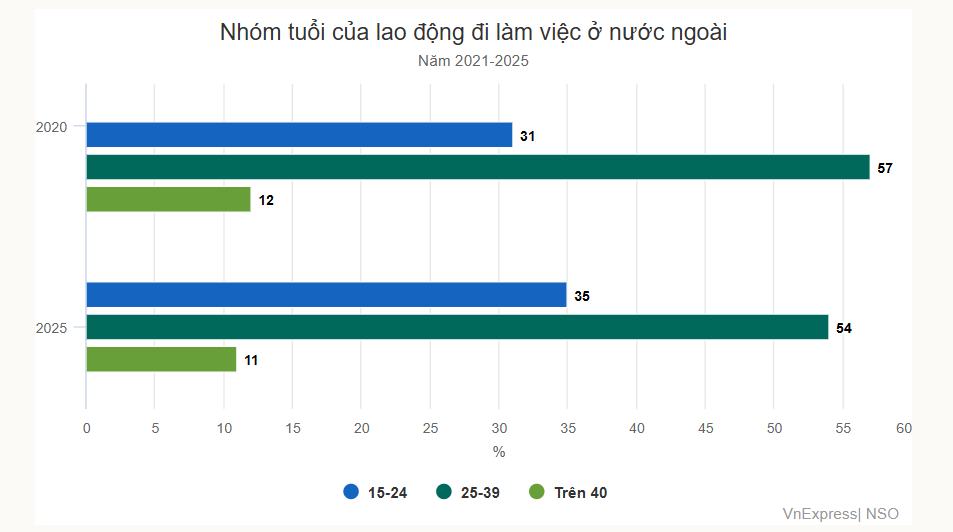
The median age of Vietnamese workers going to work abroad is around 27, a decrease of one year compared to 2021 and significantly lower than the group working domestically
According to a report published by the General Statistics Office in September, approximately 412,000 Vietnamese people will work abroad during the period 2022-2025. The median age of this group decreased from 28 to 27. This means that half of those working abroad are under 27 years old, and half are 27 years old or older. Meanwhile, the median age of workers employed domestically is 40-42.
Another indicator of the age structure of those going abroad for work is the increasing proportion of unmarried individuals, rising from 52% in 2021 to 61% in 2025. This report is based on the 2025 Labour and Employment Survey and in-depth survey of migrant workers.
The origin of the workforce is also changing. In 2021, approximately 83% of those working abroad came from the North Central region (Thanh Hoa, Nghe An, Ha Tinh, Quang Tri, Hue City) and the Red River Delta (Hai Phong, Hung Yen, Bac Ninh, Ninh Binh, Hanoi). By 2025, the proportion of workers from the Northern Midlands and Mountains (Phu Tho, Tuyen Quang, Thai Nguyen) and the Mekong Delta (Can Tho, Vinh Long) is expected to increase from 12% to 23%.
Approximately 80% of migrants have completed high school. Despite improved educational attainment, the jobs they take on remain concentrated in low- or medium-skilled industries. Manufacturing alone accounts for 45%; other sectors include construction, agriculture, trade, automobile and motorcycle repair, and accommodation and food services.
Income disparities are clearly reflected in occupational skill levels. Managerial and high-level technical and professional workers earn approximately 51.7 million VND per month, nearly double the average of 28 million VND. Unskilled laborers receive over 24 million VND; skilled technicians, agricultural workers, and those in handicrafts mainly earn between 27-29 million VND.
According to the Statistics Bureau, this difference shows that vocational training, technical skills, and foreign languages play an important role if workers want to access higher-paying jobs. The agency recommends that training should be closely aligned with the needs of each receiving market.
Vietnamese workers have gone to work in 42 countries and territories, but nearly 77% are concentrated in Japan, South Korea, and Taiwan. The General Statistics Office recommends expanding to markets with stable recruitment demand, good working conditions, and income to give workers more options and reduce risks when the acceptance policies of a market change.
_Collect_