
Digitalizing Seaports: Paving the Way for Vietnamese Goods to Reach Further
According to Mr. Nguyen Canh Tinh, Chairman of the Board of Directors of Vietnam Maritime Corporation (VIMC), digital transformation not only enables seaports to operate faster and more accurately but also creates new competitive advantages for businesses.
When data is transformed into productivity and technology into service quality, smart seaports can help shorten processing times, reduce logistics costs, and enable Vietnamese goods to reach further markets.

Deep-water ports can only truly realize their full potential when they attract major shipping lines, establish stable cargo volumes, and foster the development of a supporting logistics ecosystem.
Every Meter of Berth and Every Investment in Equipment Is Aimed at Reducing Logistics Costs
For businesses in the transportation sector, the spirit of “leading the way and paving the road” is not merely a slogan, but a mandate arising from practical production and business activities. At VIMC, how has this spirit been cultivated and transformed into a corporate culture that makes every employee proud to be a “pathfinder”?
For us, “leading the way and paving the road” does not simply mean making use of what already exists. It means anticipating the future needs of the economy and building the necessary capacity today.
If we do not proactively invest in infrastructure, innovate through technology, and organize logistics chains effectively, Vietnamese goods will continue to take indirect routes, while businesses will have to bear additional costs and longer transit times.
Today’s “pathfinders” may be engineers working on construction sites in harsh weather conditions, ship captains navigating vessels through complex maritime routes, workers operating equipment with precision, managers boldly proposing new approaches, or digital specialists transforming traditional processes.
Every initiative, whether large or small, can create value for both businesses and customers.
And this spirit of transportation professionals also reflects “courage, intelligence, and creativity,” such as building deep-water ports capable of accommodating the world’s largest vessels?
In reality, behind the safe arrival of ships carrying hundreds of thousands of tons of cargo lies a long process of surveying, planning, investment, dredging, infrastructure development, navigation channel management, equipment investment, and—most importantly—the continuous development of human capabilities.
For deep-water ports such as Cai Mep–Thi Vai and Lach Huyen, the challenges are even greater. An international gateway port requires more than just berths. It must have sufficiently deep navigation channels, turning basins, suitable berth structures, equipment capable of handling large vessels, and a well-integrated transportation network.
We view these projects not simply as port infrastructure developments, but as essential links in Vietnam’s national logistics system. Every meter of berth constructed, every piece of equipment invested in, and every operational process improved is aimed at reducing logistics costs, shortening cargo transit times, and strengthening the competitiveness of Vietnamese businesses.
However, building a port is only the first step. A deep-water port can only truly maximize its value when it attracts major shipping lines, generates stable cargo volumes, and stimulates the development of a broader logistics ecosystem.
Through every project, we have come to understand more deeply that courage is needed to make decisions, intelligence to make the right choices, and creativity to transform infrastructure into competitive advantage.
A pathfinder does not simply build a road; they must ensure that the road is used and that it enables people and businesses to travel further and further.
The Can Gio International Transshipment Port Project is also expected to become a major catalyst for Vietnam’s ambition to become a maritime hub for the region and the world. How has the spirit of a new generation of transportation professionals been embodied in this project?
The question that concerns us most regarding the Can Gio International Transshipment Port is how an infrastructure project can evolve into a maritime ecosystem capable of competing at both regional and international levels.
Building a port is already challenging. It is even more difficult to persuade shipping lines to choose the port, attract cargo to the port, and develop a thriving logistics ecosystem around it.
On April 29, 2026, the consortium comprising VIMC, Saigon Port, and TIL—an MSC subsidiary—was officially granted approval as the project’s investor.The project is expected to require a total investment of VND 128.873 trillion, with investment planned in phases from 2026 to 2045.

Mr. Nguyen Canh Tinh, Chairman of the Board of Directors of Vietnam Maritime Corporation (VIMC).
This is not a short-term investment decision, but a commitment to a vision that spans decades. We are fully aware that Can Gio will have to compete with long-established maritime hubs in the region. Therefore, the mindset of “build a port and wait for cargo to come” is no longer appropriate. Our approach must be proactive: securing cargo sources, building connectivity networks, and developing a strong logistics ecosystem capable of sustaining long-term cargo volumes.
Another key concern is how to develop the project in a modern, green, and sustainable manner while maintaining harmony with Can Gio’s natural environment.
I believe that the spirit of “leading the way and paving the road” in this project means having the courage to look beyond a single investment cycle. Those who lead the way must be willing to undertake work whose full results may not be realized for many years. That is why we must approach every decision with scientific thinking, careful consideration, and great ambition.
If successful, Can Gio will be more than just a seaport. It could become a new gateway for Vietnam to participate more deeply in global logistics networks and demonstrate the country’s capacity to develop its maritime economy.
This is also how VIMC puts the spirit of Resolution No. 79-NQ/TW into practice: taking the lead while ensuring effectiveness, daring to act while taking responsibility, and investing in the future while creating tangible value for the country.
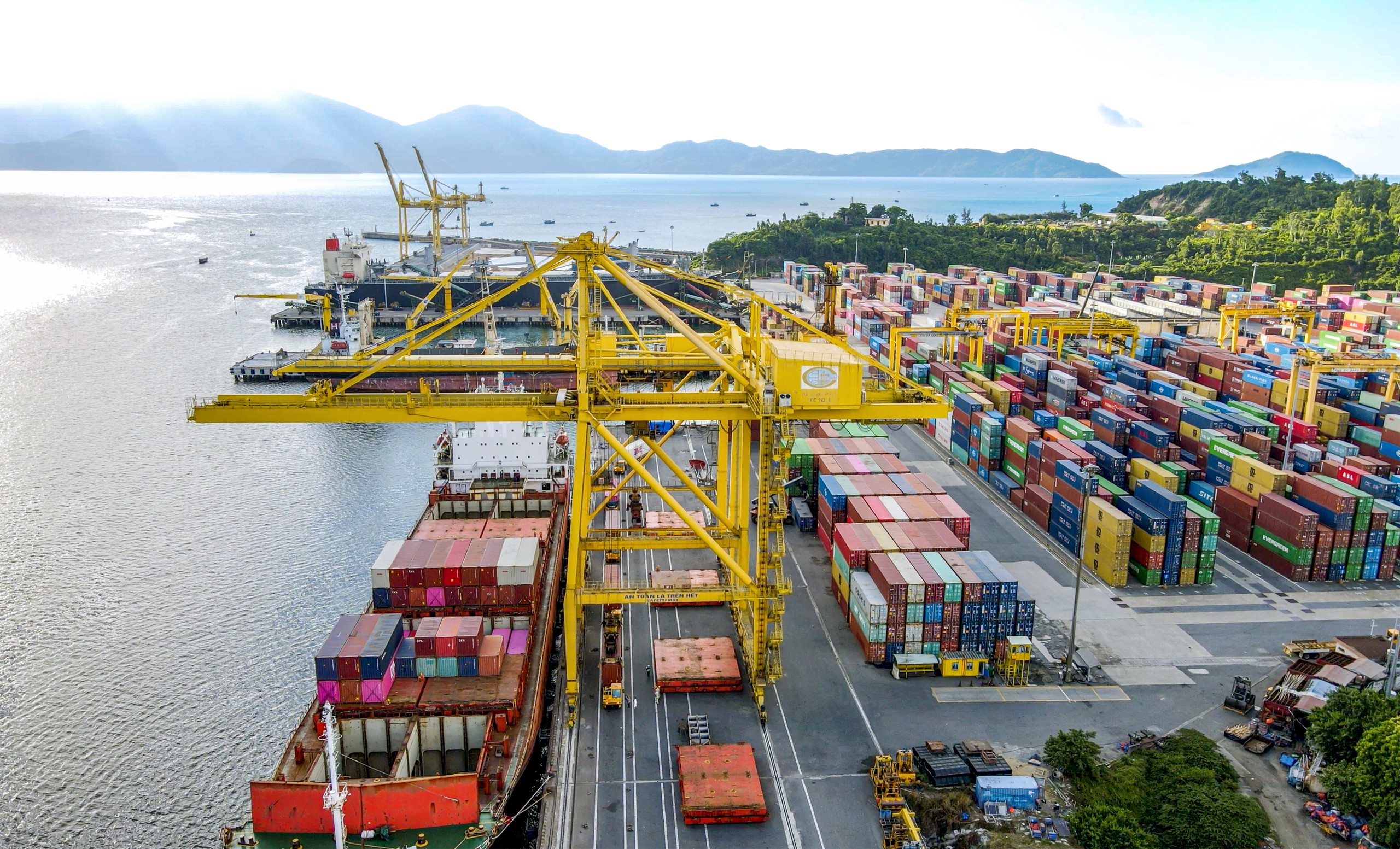
VIMC is implementing the smart port model across its member units, making science and technology, innovation, and digital transformation key drivers for enhancing competitiveness, modernizing management, and achieving sustainable development.
Technology Helps People See Further and Work More Efficiently
Infrastructure development today requires more than human effort—it also requires technology. In your view, is businesses’ strong investment in digital transformation and modern equipment a way of embodying the spirit of intelligence and innovation in the new era?
When a vessel arrives at a port, behind the continuous movement of cranes loading and unloading containers lies a system that must operate with precise coordination. The vessel’s arrival time, the availability of berths, where containers should be stored, which equipment needs to be deployed, and the most efficient cargo-handling methods must all be planned in advance.
A delay at any stage can affect the entire process. Therefore, if seaports are gateways connecting the economy to the world, technology is the tool that helps those gateways open faster, operate more accurately, and compete more effectively.
That is why VIMC has identified digital transformation as a core component of its development strategy. We are implementing Resolution No. 57-NQ/TW by making science and technology, innovation, and digital transformation key drivers for enhancing competitiveness, modernizing management, and achieving sustainable development.
Digital transformation must begin with specific tasks at berths, container yards, operations control centers, and customer service departments. Technology must solve real-world problems. Innovation must deliver clear and measurable results in terms of productivity, time, cost, or service quality.
A modern port must be capable of operating quickly and accurately. Data enables managers to know when vessels are expected to arrive, the estimated volume of cargo, what equipment needs to be deployed, and how much capacity remains available in the port yard. When information is continuously updated, businesses can take proactive action instead of waiting for problems to occur.
Based on this approach, we are implementing smart port models across our member units. Solutions such as SmartGate, AutoGate, electronic payment, and electronic delivery orders help reduce paperwork, shorten waiting times, and minimize manual transactions.
Data across ports, shipping, and logistics is also gradually being interconnected to support operations, forecasting, and faster decision-making.
However, digital transformation requires businesses to change their management practices, standardize processes, establish strong data discipline, and train employees to master new technologies. Therefore, we integrate technology investment with safety, energy efficiency, environmental protection, and improved customer service quality.
We always encourage our managers and employees to think boldly, take initiative, and experiment with new solutions in a controlled manner. At the same time, we promote and draw on initiatives from those who work directly at ports, on vessels, and throughout the logistics chain.
Technology does not replace people. Technology helps people see further, make decisions faster, and work more efficiently. The creativity of today’s maritime professionals lies in transforming data into productivity, technology into service quality, and gradually turning every seaport into a smart and efficient link in the supply chain.
In this context, what message would you like to share with today’s generations so that they can confidently embark on new voyages and elevate Vietnam’s position on the global stage?
There will always be unexplored waters. Likewise, every generation has new voyages that previous generations have not been able to complete.
I would like to encourage today’s young people to take pride in Vietnam’s maritime traditions, but not to be satisfied with what has already been achieved. Have the courage to take on difficult tasks, work with a scientific mindset, embrace innovation proactively, and create tangible value for the country.
Previous generations built the foundations under far more challenging circumstances. They maintained the country’s transport routes, ports, shipping fleets, and maritime navigation channels.
Today’s generation must continue to build upon those foundations in an entirely new competitive environment. Ships are becoming larger, supply chains demand greater speed, technology is changing every day, and standards for environmental protection and service quality are becoming increasingly demanding.
Therefore, we must learn faster, collaborate more broadly, manage more transparently, and transform practical initiatives into the competitive strengths of our businesses.
_Collect_