
Seaports – strategic gateways to the economy
Strategic infrastructure is becoming the "gateways" that connect Vietnam more deeply with the region and the world. As infrastructure leads the way, new flows of economic activity, trade, and international exchange begin to take off.
On August 4th, the container ship LI DA TONG 2 HAO docked at Can Tho port, concluding its trial voyage on the shipping route connecting Nanning (Guangxi, China ) with Can Tho.
This voyage was organized by the Vietnam Maritime Corporation ( VIMC ), Can Tho Port Joint Stock Company, in coordination with the Beibu Gulf Port Group (China) and logistics partners, to assess the feasibility of operating a direct shipping route between the two regions.
More than just a test voyage, this journey also carries crucial data on operating conditions, market demand, and operational efficiency. This will form the basis for evaluating the feasibility of establishing a regular container shipping route between Nanning and Can Tho .
If the transportation route is put into stable operation, businesses will have an additional transportation option at a reasonable cost, contributing to improved supply chain efficiency and promoting green and sustainable transportation.
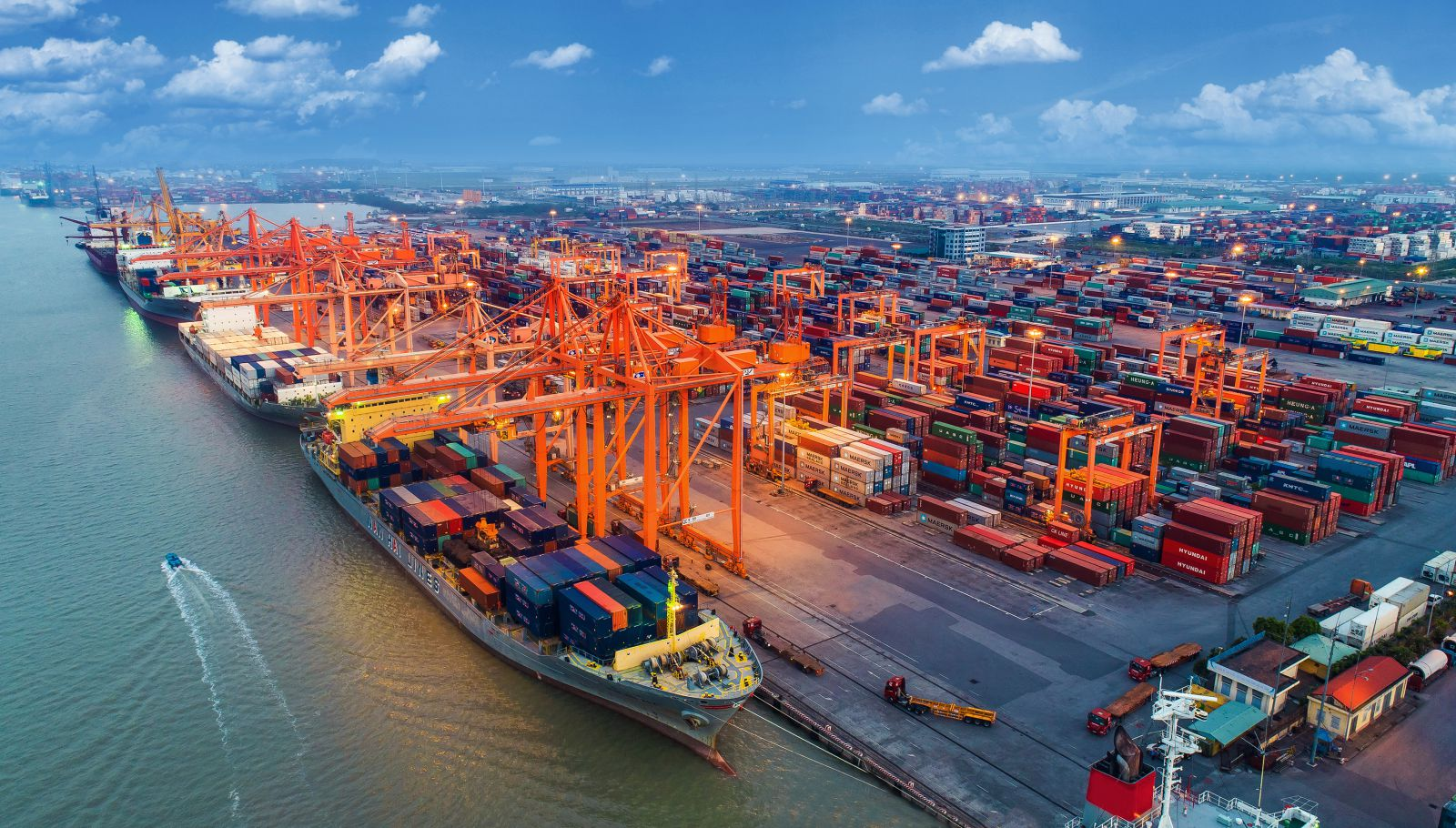
The story at Can Tho port illustrates an increasingly clear direction for the maritime industry: seaports are not just places to receive ships, but are gradually becoming connecting points for goods flows, expanding the trading space of the economy .
Over the years, VIMC has stated that investing in deep-water ports at Cai Mep - Thi Vai and Lach Huyen has created strategic maritime gateways, directly connecting Vietnam with trans-Pacific and European shipping routes.
At Lach Huyen, Berths 3 and 4 are a joint venture between VIMC and MSC/TiL, capable of receiving mother vessels of 165,000 DWT and carrying 14,000 TEU, and will be further upgraded to receive vessels over 200,000 DWT.
Meanwhile, Cai Mep International Port (CMIT), a joint venture between VIMC, Saigon Port, and APM Terminals, is capable of receiving super container ships up to 214,000 DWT, with a carrying capacity of over 18,000 TEU. SP-SSA International Port also has the capacity to receive ships over 200,000 DWT.
Along with the expansion of ship handling capacity, the volume of goods passing through the seaport system is also constantly increasing. According to VIMC, the volume of goods handled through seaports is expected to increase from 706.1 million tons in 2021 to approximately 940.3 million tons in 2025.
The operational capacity of the port system has been significantly improved. The Lach Huyen port area (Hai Phong) can accommodate container ships up to 165,000 DWT, while the Cai Mep port area ( Ho Chi Minh City) can accommodate ships up to 232,000 DWT.
The greater significance lies in the ability to deliver Vietnamese goods directly to major markets such as the US and Europe without having to go through transshipment ports in the region.
At that time, port infrastructure was no longer simply a place where goods passed through, but truly became the gateway to the economy, shortening the journey from domestic production to the global market.
By 2025, the total cargo throughput of the VIMC port system is expected to reach approximately 162 million tons, accounting for about 20% of the total cargo throughput of Vietnam's ports. The entire system currently has more than 40 international shipping routes connecting Vietnamese ports with the Americas and Europe, and hundreds of routes connecting within the intra-Asia region.
These figures demonstrate that the maritime network is constantly expanding, creating more direct connections and new transportation options for businesses.
_Collect_